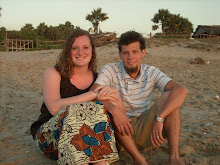
I think that we have determined that if there is one thing that we want us to take away from our time here it would the Gambian view on hospitality. This view isn't unique to Gambia, but it's quite different from our cold climate culture view.
At home, for someone to come to a meal, we plan on them coming, then we make sure our house is clean and we make something that's not too expensive and can stretch a bit, but that is also tasty. We might bring out nice plates and silverware, or put a nice tablecloth on the table. No matter how we go about it, we usually prepare in some way, yet we still usually withhold the best, saving it for ourselves and our families.
Here in Gambia hospitality is much more relaxed and in many ways I would say it comes more from the heart. On any day, at any given time we could show up at one of our groups and if anyone was eating we would also be invited to eat. It would never cross their minds to think "well I only made enough for 5 and now there's 7 of us", rather, the thought process would be that it would be rude not to offer their food to us. In fact, food is one of the few things that they can offer us, so at times it can be offensive if we don't eat at least some of the food that we are offered. Also, it is always guaranteed that we will have plenty of fish is in our section of bowl, even if that means that others go with less, since we are the guests. In addition, whatever crop is in season we are usually offered and/or sent away with. Stools or chairs are made available for us to sit on, and in some cases the conversation then moves away from the flies.
While my parents were visiting, we headed out to Kiti and Tiu Jon had just finished sealing two new rooms with concrete. These are going to be where his sister is staying, but at that time they were still drying. He was so proud of these rooms that he invited all of us to sit on mats on the floor, chat with him, host our Bible study inside and even eat in the new rooms! This resulted in rice on the floor and then it needed to be swept, but I feel that this showed his true heart of hospitality. He wanted to give us the best that he had. He could have proudly showed us the room, then had us eat outside, but instead he welcomed us in to enjoy what he had worked so hard to construct.
I have to admit, I am not the best house keeper. While I enjoy cooking and preparing meals, cleaning is not my strong point. I find that both Elias and I are are fairly careless as we set things down, which leads to items piling up. I also have a hard time finding space for all of the odd items that we own. This results in me scurrying around as I try to make our apartment at least presentable for whoever is coming, or being embarrassed by by what I see as a mess, even if the other person doesn't notice. I feel like I'm rarely prepared for people to just show up, which is fairly common here in Gambia, and when they do I have trouble focusing on them rather than that cleaning that I should have done before this point. I also find myself being the person that says "but we don't have enough food for anyone else". In many ways, with our American cooking style this is true. We don't all eat out of one bowl until we are full, instead we have our own plates and we take our portion. Since there are only 2 of us currently and we only have a fridge that comes up to my hip, with a tiny freezer that doesn't usually freeze and electricity issues, I try to make small meals with little to no leftovers. I also can't store many extras for this same reason if they need to be kept cold. But, I have found that even with this cooking style, there is always enough to share. If that means taking less for ourselves and improvising later, then so be it. Not having enough to share is usually more of an excuse for not wanting to share our precious meat that we only get about twice a week rather than a reality.
As I think more about this, I'm reminded of the story in the Bible about Mary and Martha. Jesus came to visit and Mary sat at his feet and just listened to him speak, but Martha let herself get so distracted by making everything presentable for Jesus, she missed out the true meaning of hospitality. Mary was the better hostess because she gave her guest her time and attention, Martha on the other hand wanted to please her guest so much that she end up neglecting him instead. I feel like the Gambians are Mary. Guests arrive, they are welcomed in and given what's available at that time. They are attended to and given the time of their hosts. We however tend to more like Martha. We spend time preparing for guests, but when they arrive we hardly enjoy them because we are distracted by all we need to do, and we deprive them of the best gift, our time and attention. This is not to say we are all like this, or that we always do this, but as a culture in general we are much more work oriented than relationship oriented.
As I go home I want to take Mary's spirit of hospitality that I have found here with me. I would love to lean to keep a tidier home so that I'm prepared for guests, but even when I'm not prepared I want my attention to be focused on them and not on what I should have been doing to prepare for their arrival. I want to give the best of what I have available and put relationship first. Elias and I have both come to value this and we pray that we can keep this desire as we step back into a time and work oriented culture.
Tuesday, October 5, 2010


Friday, September 10, 2010
The Fish Market
After this title I feel like there should be that music that goes "dun dun dun..." in a movie that signifies that nothing good can come from the current situation. This is how I feel about the Brikama fish market.
When we first moved to Brikama there was a large structure being built in the middle of the market that was hidden behind walls. We spent a few months wondering what it would be and when it would be done. One day however, the walls were down and what was revealed to use was a large building with concrete tables. We still had no idea what this building was going to be used for, but all we knew was that it was in the middle of the market. We eventually found out that it was to be the new fish market.
Prior to this building fish would be sold in various parts of the market from bucket or a little stand made of wood with a tin roof. It was fairly easy to pic up fish on your way to buying other items if you so desired. This did make the majority of the market quite smelly and it wasn't uncommon to try and avoid fish parts or fish fluids when trying to maneuver the narrow walkways throughout the market. But now a building has been erected for all the people selling fish and with large ice chests to keep the fish. This isn't a bad idea. All the smell is condensed in one building and you know when you enter into the building that you will have to avoid fish parts and fluids, for which drainage has been made.
However...I for some reason, find the fish market to now be extremely intimidating! I hate the thought of having to go and pick out fish. I never thought I would actually have to experience this part of the market until we were in Ramadan. Our cook, Agnus, informed us that during Ramadan, fish would not be available until the afternoon or evening. We usually have Agnus go on Monday morning with money to pick out what she would need for the week, but since fish was not available in the morning and she lives quite a long distance from the market, she asked if we could go in the evening and get it. As much as I dreaded it, I knew we had to agree.
So one day, when we had the car and my parents were here, we ventured for the first time into the dreaded fish market. The closer we got the stronger the smell became, and as we passed by buckets of fish parts we were greeted by swarms of flies that had been feasting on these fish remains. Then we arrived at the area where the fish is actually sold and we have to face all these tables where everyone is looking to sell you their fish, yet we have no idea what kind of fish we should even get! So, we chose the first table we came to, bought 3 fish for 10 Dalasi, about $0.37, and headed home. The next day we discovered that we bought the worst fish that we could have chosen as it is very boney and has a strong flavor that neither my father nor I appreciated very much. But, much to our demise, we would get another chance the following week to try again.
The following week went a bit better as it was later in the day and there were less vendors and less fish. This time we went after the smaller, less boney fish and we were successful! This being said, I don't think that trips to the fish market will become a regular part of my week if I can possibly avoid it. Thankfully Ramadan is now finished and the job of fish buying will return to Agnus.


When we first moved to Brikama there was a large structure being built in the middle of the market that was hidden behind walls. We spent a few months wondering what it would be and when it would be done. One day however, the walls were down and what was revealed to use was a large building with concrete tables. We still had no idea what this building was going to be used for, but all we knew was that it was in the middle of the market. We eventually found out that it was to be the new fish market.
Prior to this building fish would be sold in various parts of the market from bucket or a little stand made of wood with a tin roof. It was fairly easy to pic up fish on your way to buying other items if you so desired. This did make the majority of the market quite smelly and it wasn't uncommon to try and avoid fish parts or fish fluids when trying to maneuver the narrow walkways throughout the market. But now a building has been erected for all the people selling fish and with large ice chests to keep the fish. This isn't a bad idea. All the smell is condensed in one building and you know when you enter into the building that you will have to avoid fish parts and fluids, for which drainage has been made.
However...I for some reason, find the fish market to now be extremely intimidating! I hate the thought of having to go and pick out fish. I never thought I would actually have to experience this part of the market until we were in Ramadan. Our cook, Agnus, informed us that during Ramadan, fish would not be available until the afternoon or evening. We usually have Agnus go on Monday morning with money to pick out what she would need for the week, but since fish was not available in the morning and she lives quite a long distance from the market, she asked if we could go in the evening and get it. As much as I dreaded it, I knew we had to agree.
So one day, when we had the car and my parents were here, we ventured for the first time into the dreaded fish market. The closer we got the stronger the smell became, and as we passed by buckets of fish parts we were greeted by swarms of flies that had been feasting on these fish remains. Then we arrived at the area where the fish is actually sold and we have to face all these tables where everyone is looking to sell you their fish, yet we have no idea what kind of fish we should even get! So, we chose the first table we came to, bought 3 fish for 10 Dalasi, about $0.37, and headed home. The next day we discovered that we bought the worst fish that we could have chosen as it is very boney and has a strong flavor that neither my father nor I appreciated very much. But, much to our demise, we would get another chance the following week to try again.
The following week went a bit better as it was later in the day and there were less vendors and less fish. This time we went after the smaller, less boney fish and we were successful! This being said, I don't think that trips to the fish market will become a regular part of my week if I can possibly avoid it. Thankfully Ramadan is now finished and the job of fish buying will return to Agnus.

So it may not look that menacing, but believe me, this is only the outside!

Picking out the boney "bongo" fish, when little to our knowledge, the small fish sitting next to it was the better option.
Tuesday, September 7, 2010
Ramadan
This week will mark the end of the month of Ramadan. Since the last new moon, all of the Muslims here have been fasting from both food and drink each day from sunrise to sunset. This has marked some changes of daily life for both Muslims and non-Muslims alike. Rather than being able to go to the market at any time of day and get water, icy treats, bread or even fish, most items don't appear later in the day when people would begin preparing to end their fast. To go to the market in the evening however, the market comes alive and their is more food available than we would even find at any other time of year.
For those of us who have tried fasting in any form we know how difficult the discipline can be. However, here it is just that much more difficult. Just because they are fasting doesn't mean that the work stops. The women are still out in the fields working in the hot sun with no water all day. For me, this puts up some red flags when it comes to health. "You can't be out in the hot sun in 100% humidity and not drink any water!" is what my brain is yelling at me. Yet, since they don't typically drink enough water according to our American standards anyway, they do it and don't realize the effects that it has on their bodies. I was even told by a Christian friend that her Muslim friend who was pregnant was trying to fast, and thankfully after trying and finding it extremely difficult, she heeded the advice of our Christian friend and chose not to fast for the safety of herself and her baby.
Overall this is a challenging month for Muslims, yet they remain faithful to what they believe. This brings some questions to mind regarding faithfulness. If you think of what you believe to be truth and then imagine that it would require you to fast everyday from sunrise to sunset for a month while maintaining a vigorous work schedule, would you remain faithful? I am thankful that as a Christian I don't have this demand put on me and that I can choose if and when I want to fast, for how long and the activities that I do during that time, yet I have been challenged by the dedication of the Muslims here and I am challenged to think about my level of dedication and commitment to what I believe to be truth and the calling that I feel that God has placed on my life.
We ask for prayer for our Muslim friends as they finish this time of fasting, and we ask that they would remain healthy and strong.
For those of us who have tried fasting in any form we know how difficult the discipline can be. However, here it is just that much more difficult. Just because they are fasting doesn't mean that the work stops. The women are still out in the fields working in the hot sun with no water all day. For me, this puts up some red flags when it comes to health. "You can't be out in the hot sun in 100% humidity and not drink any water!" is what my brain is yelling at me. Yet, since they don't typically drink enough water according to our American standards anyway, they do it and don't realize the effects that it has on their bodies. I was even told by a Christian friend that her Muslim friend who was pregnant was trying to fast, and thankfully after trying and finding it extremely difficult, she heeded the advice of our Christian friend and chose not to fast for the safety of herself and her baby.
Overall this is a challenging month for Muslims, yet they remain faithful to what they believe. This brings some questions to mind regarding faithfulness. If you think of what you believe to be truth and then imagine that it would require you to fast everyday from sunrise to sunset for a month while maintaining a vigorous work schedule, would you remain faithful? I am thankful that as a Christian I don't have this demand put on me and that I can choose if and when I want to fast, for how long and the activities that I do during that time, yet I have been challenged by the dedication of the Muslims here and I am challenged to think about my level of dedication and commitment to what I believe to be truth and the calling that I feel that God has placed on my life.
We ask for prayer for our Muslim friends as they finish this time of fasting, and we ask that they would remain healthy and strong.
Monday, August 30, 2010
How quickly we forget
"I will never take _____ for granted again!" How many times do we find ourselves either thinking this or saying this when we have something that we have missed for a period of time. I can't even begin to count the number of times since being here that I have used that phrase. It usually comes at the time of a cold shower, or the blessing of a warm one, that I think or even verbalize that I will "never" take hot water for granted again. Recently it has been electricity as power outages have been more frequent and for longer periods of time. We can almost expect each night that our electricity will go out between 6-8 p.m. and not resume until sometime throughout the night, leaving us in the dark, breezeless night with the humidity settling in around us like a heavy blanket. This is more of a frustration and inconvenience than anything else, but unfortunately we do rely on electricity to keep medications cold and with temperatures like ours, our little refrigerator has trouble keeping the cold in, or even getting cold for that matter when we do have electricity.
I also tend to think about this phrase when it comes to rain, the cold, always having running water at our fingertips and having the convenience of a vehicle. But the biggest event that triggered this thought recently was the use of a washing machine!
A few days ago, we were blessed to once again to have family here in Gambia. My (Jessica's) parents came to visit for 9 days. We decided to take a couple of days in the city to enjoy some A.C., a pool, satellite tv, hot water and much to my delight: our very own washing machine! Usually if we go somewhere with a washing machine we have to pay someone to do our wash for us, but at this particular place we were able to do it ourselves. You may find yourself laughing at this, but after washing clothes by hand for 9 months, it is amazing to use a washing machine and to realize how dry clothes get when spun rather than hand rung! Elias and I actually made the 30-40 min. drive back to our house just to get the rest of our laundry so that we wouldn't have to do it by hand later in the week.
As exciting as this may be, it got me thinking about how may times we say that we won't take something for granted ever again and then in a matter of weeks, or maybe a couple of months if we're fortunate, we have forgotten and begin complaining about the very thing we were never going to take for granted! Even I have to admit that before I know it, I'll be complaining about having to take the time to put the clothes in the washer, let the machine do the work and then take the time to hang them on the line. Or I will be stepping into the hot shower, because I have to without even thinking about the hundreds of cold showers that I had to take here. When we experience the infrequent power outage at home, it will most likely be followed by surprise and possibly groans if it interferes with our daily routine.
I then began to think about how we even do this with people, especially our families. After having Elias' family and then my parents come to visit, we were reminded how nice it is to have time with family and how much we do actually miss them. Yet when we get home, we may find ourselves getting irritated with the very people that we missed so much while here. I would love to think that I will never take the blessing of family for granted, but I know that all too often that is exactly what happens. And as I thought about how quickly we take for granted our immediate family, I began to think about our church family and how this so easily happens with the body of Christ. Rather than recognize the gifts that others have to offer, we argue about our differences. Or rather than complimenting our pastors on all the work they do, we nit pick and complain about what they aren't doing.
Which then brings me to think about how often we take God himself for granted. In times of need, we cry out with all our being, and when He answers, we promise to be more faithful, make more time for Him and never take for granted how He provides for us and blesses us. Then things get better and we find that it has been days, weeks or even months since we sat down and read our Bible or prayed to the One who carried us through our time of suffering. We forget all of His blessings such as the blessings of food, shelter, clothing, work. We forget to thank Him for our families and lift them up to him, especially when we're irritated with them. We forget to thank Him for the body of Christ and how He made us each unique yet in His image so that we can show others, who our God is and bring His kingdom here to earth. This is coming from personal convictions that I know I have to work on, but I think that it is all too common in most of our lives. My prayer is that we can strive to remember all of our blessings, big and small, and truly not take things for granted rather than just saying that we won't.
I also tend to think about this phrase when it comes to rain, the cold, always having running water at our fingertips and having the convenience of a vehicle. But the biggest event that triggered this thought recently was the use of a washing machine!
A few days ago, we were blessed to once again to have family here in Gambia. My (Jessica's) parents came to visit for 9 days. We decided to take a couple of days in the city to enjoy some A.C., a pool, satellite tv, hot water and much to my delight: our very own washing machine! Usually if we go somewhere with a washing machine we have to pay someone to do our wash for us, but at this particular place we were able to do it ourselves. You may find yourself laughing at this, but after washing clothes by hand for 9 months, it is amazing to use a washing machine and to realize how dry clothes get when spun rather than hand rung! Elias and I actually made the 30-40 min. drive back to our house just to get the rest of our laundry so that we wouldn't have to do it by hand later in the week.
As exciting as this may be, it got me thinking about how may times we say that we won't take something for granted ever again and then in a matter of weeks, or maybe a couple of months if we're fortunate, we have forgotten and begin complaining about the very thing we were never going to take for granted! Even I have to admit that before I know it, I'll be complaining about having to take the time to put the clothes in the washer, let the machine do the work and then take the time to hang them on the line. Or I will be stepping into the hot shower, because I have to without even thinking about the hundreds of cold showers that I had to take here. When we experience the infrequent power outage at home, it will most likely be followed by surprise and possibly groans if it interferes with our daily routine.
I then began to think about how we even do this with people, especially our families. After having Elias' family and then my parents come to visit, we were reminded how nice it is to have time with family and how much we do actually miss them. Yet when we get home, we may find ourselves getting irritated with the very people that we missed so much while here. I would love to think that I will never take the blessing of family for granted, but I know that all too often that is exactly what happens. And as I thought about how quickly we take for granted our immediate family, I began to think about our church family and how this so easily happens with the body of Christ. Rather than recognize the gifts that others have to offer, we argue about our differences. Or rather than complimenting our pastors on all the work they do, we nit pick and complain about what they aren't doing.
Which then brings me to think about how often we take God himself for granted. In times of need, we cry out with all our being, and when He answers, we promise to be more faithful, make more time for Him and never take for granted how He provides for us and blesses us. Then things get better and we find that it has been days, weeks or even months since we sat down and read our Bible or prayed to the One who carried us through our time of suffering. We forget all of His blessings such as the blessings of food, shelter, clothing, work. We forget to thank Him for our families and lift them up to him, especially when we're irritated with them. We forget to thank Him for the body of Christ and how He made us each unique yet in His image so that we can show others, who our God is and bring His kingdom here to earth. This is coming from personal convictions that I know I have to work on, but I think that it is all too common in most of our lives. My prayer is that we can strive to remember all of our blessings, big and small, and truly not take things for granted rather than just saying that we won't.
Saturday, August 14, 2010
Anniversary Vacation
From August 3-10 we went to the city for a week of vacation to celebrate our anniversary. Overall the week was pleasant and restful, only after following a few days of stress which God used to bless us in the end. We chose a hotel with self catering apartments on the beach so that we would still be able to cook our own meals while enjoying the ocean that we rarely see at home.
The first day that we arrived we found out that we had to supply our own cash power which is basically like phone credit but for electricity. This was a little frustrating, but we went out and bought our cash power while getting groceries with the team and all was well...until we got back to the hotel that is. Upon entering our cash power into the meter we discovered that the meter was broken and since the power can't be transferred from meter to meter our money would either go to waste or the meter had to fixed. We opted for the meter being fixed. So for the first few hours we had no electricity until they decided to wire our meter to another meter to use the left over cash power on that meter until our meter was fixed the next day. We readily agreed to this arrangement which in the end provided us with just enough cash power for the week.
The next day however we woke up and discovered that our computer cord had been fried by the power outages and flipping of breakers the previous day and throughout the night. Unfortunately, while we love our Mac laptop, finding Apple products in Gambia is like finding a needle in a haystack that may or may not even be in the haystack. We did find one man who said he could get a cord in a couple of days, but then we found another man who thought he could fix the cord. So we left the cord and agreed to come back the next day. This took about half the day which also added to our frustration, but it was turned around into a blessing considering we were in the city where we were able to easily check about power cords and return in a day where as if we had been in Brikama the travel would have been even more difficult and stressful. We were also happy to arrive back at the hotel and find that the satellite TV had been fixed and we were able to enjoy some different shows that we have never seen or at least not in about a year along with some of our favorite movies that were playing.
So once again the next day we set out and discovered that our cord could not be fixed, but it could be spliced to another power cord until my parents arrive with a new cord. We also discovered that the man that would "repair" our cord had an Apple cord but it was 24 V instead of 16 V which would have fried our computer. With this knowledge we decided that rather than wait another day for the other place to get an Apple cord which may also be 24 V we would trust these men who actually knew what they were doing to provide a temporary fix. This was a success and the rest of the week went quite smoothly!
The rest of the week we were able to enjoy swimming in the ocean, see a sea turtle be set free that had been caught in a fishing net, just relaxing and of course celebrating our two year anniversary in West Africa! We decided that the hotel we went to wouldn't be our first choice for another vacation, but it served it's purpose and God was faithful!
Here are some pictures from our time in the city:

kitchen/dining room area

living room

balcony

bedroom


View from our balcony


enjoying the ocean

Apparently every Sunday during the off season until Ramadan there is a beach party where thousands of Gambians go to swim, eat, dance and just have a big celebration. We were unaware of this initially when we went swimming on Sunday, but Sunday evening after going out for dinner we decided to walk back to our hotel along the beach and this is part of what we saw. The picture doesn't do it any justice compared with how many people were really there. It was really nice to see this though since Gambians don't get too many opportunities to enjoy the beach.
Prayer requests:
-My parents will be leaving on Monday the 16th and arriving on the 17th. We would like prayer for safe and easy travels and just a blessed time with them here.
-Our teammate Lori leave on Sunday the 15th to return to the States. Please pray for all of her travels as well
-For rain! We need a lot of rain this month or there will be problems and it is actually very dry!
Praises:
-We had a wonderful vacation overall
-We have met a new friend who is a Peace Corp worker, but lives in the Methodist Mission here as well
-We will once again be able to enjoy time with family!
Thursday, July 22, 2010
Women of the Gambia
Here in Gambia women work harder than any other women I know. Every day is spent either in their gardens in the hot sun, cooking for their family along with others that happen to be there, pounding different items such as rice, cous, millet, fish, etc, washing laundry and taking care of their children among other things.
One example in particular that comes to mind is one of our youth. Her name is Miriama and she lives in Pirang at the house where we do our weekly Bible study. Each week we arrive and Miriama is busy at work until the rest of the youth come and then she sits down for our study and as soon as it is over she is back to work. Some days we arrive and she is busy hauling water from the school that is some distance away from the house. Other days she is pounding, washing clothing or doing some other work in the house or outside with others that live in the compound. While Miriama is a prime example of a hard worker, she is by far not alone in the heavy workload that women face.


Another example is the compound that we hold studies at in Kiti. Any day of the week that we come to Kiti the women are going about their various work. The only time that I have seen them rest is Sunday afternoon where they take time to braid each other's hair.
This isn't to say that men don't work here, and there are some very hard male workers here in Gambia, but while it is a fairly common sight to see men sitting under a tree in the afternoon drinking tea, the women are usually busy at work. This is an example of the oppression that women still face here in Gambia. While it may not be as extreme as in other cultures, men are still viewed more highly than women as a general rule. Women however, are beginning to stand up for their rights a bit as they become more exposed to western culture and see how other women live. This can be seen in areas such as clothing and marriage. While skirts are still the most common form of clothing for women, more and more women are choosing to wear pants or jeans, especially for special occasions. Women are also stepping out and saying that they want to be their husband's only wife rather than being one of 3 or 4 which is also still quite normal.
Unfortunately this heavy workload has not come without consequence. Many of the women here suffer from back pain and hip or leg pain from carrying water, bending over their gardens for hours at a time, washing clothes by hand, hours of pounding and pregnancies/childbirth. Each day I am thankful that I don't have to garden in the sun on days that are 110 degrees or more for a living. As I watch the women, I know that I could not physically do the work that they do and I continue to develop a whole new respect for them. I am also reminded how tremendously blessed I am to have been granted the life that I have. We wouldn't consider ourselves patriotic people, but I will admit that I am continually made more aware of how different my life would be if I had been born and raised somewhere else.
One example in particular that comes to mind is one of our youth. Her name is Miriama and she lives in Pirang at the house where we do our weekly Bible study. Each week we arrive and Miriama is busy at work until the rest of the youth come and then she sits down for our study and as soon as it is over she is back to work. Some days we arrive and she is busy hauling water from the school that is some distance away from the house. Other days she is pounding, washing clothing or doing some other work in the house or outside with others that live in the compound. While Miriama is a prime example of a hard worker, she is by far not alone in the heavy workload that women face.


Miriama pounding rice

carrying water, even the smallest children start carrying things on their heads
This isn't to say that men don't work here, and there are some very hard male workers here in Gambia, but while it is a fairly common sight to see men sitting under a tree in the afternoon drinking tea, the women are usually busy at work. This is an example of the oppression that women still face here in Gambia. While it may not be as extreme as in other cultures, men are still viewed more highly than women as a general rule. Women however, are beginning to stand up for their rights a bit as they become more exposed to western culture and see how other women live. This can be seen in areas such as clothing and marriage. While skirts are still the most common form of clothing for women, more and more women are choosing to wear pants or jeans, especially for special occasions. Women are also stepping out and saying that they want to be their husband's only wife rather than being one of 3 or 4 which is also still quite normal.
Unfortunately this heavy workload has not come without consequence. Many of the women here suffer from back pain and hip or leg pain from carrying water, bending over their gardens for hours at a time, washing clothes by hand, hours of pounding and pregnancies/childbirth. Each day I am thankful that I don't have to garden in the sun on days that are 110 degrees or more for a living. As I watch the women, I know that I could not physically do the work that they do and I continue to develop a whole new respect for them. I am also reminded how tremendously blessed I am to have been granted the life that I have. We wouldn't consider ourselves patriotic people, but I will admit that I am continually made more aware of how different my life would be if I had been born and raised somewhere else.
Thursday, July 8, 2010
Family
Recently we were blessed to welcome Elias' parents and sister into a little bit of our life here in Gambia. We picked them up from the airport early on the morning of the 23rd of June and said a bitter sweet goodbye on the July 4th. During their time here we were blessed to have some peaceful days of rest along with showing them a little bit of our daily routine. We took two days at a hotel, called Hibiscus House, that Elias and I had been wanting to go to ourselves and enjoyed sun, a pool and each other's company. We returned from Hibiscus house and the following day headed out to Kiti so that they could meet the youth that we meet with their and some dear friends that we have made by going out there. While we were there, we again encountered true Gambian hospitality by receiving cashew apples and a typical Balanta dish that they cook in this compound made with rice, fish, mango and palm oil. The compound was also in the middle of the process of preparing palm oil that would be put into large jugs and then sold at the market. From this process they are also able to make their own soap, so I explained to some of the youth that in the United States many people are trying to live more naturally and make their own things where as here in Gambia they have no choice, it is just second nature. The palm oil making process would seem quite primitive for us, for lack of a better would. No fancy machinery just fire and big metal oil oil drums with hoses connecting the ones that need oil transfered from one drum to another.
Also while in Kiti, we showed Elias' family the nearly finished pig house project that Tiu Jon has been working on throughout our time here. When I say nearly finished I mean the outside is finished but the flooring still needs to put in. After lunch and time conversing, we had our lesson with the youth, took a few pictures and headed on our way, having to refuse the gift of a liter of palm oil that would be difficult for the Zehr's to take home, but choosing some homemade soap instead.
Monday we borrowed the car to go grocery shopping since the five of us filled up the car without any room for the rest of the team. We make a stop at the Brikama craft market to pick up some hand carved items then headed off to the pool that is next to the ocean so that the family could experience both at once. We then picked up our groceries and headed home, returning the car to Pirang for the rest of the team to do their shopping the next day.
The rest of the week was spent bird watching, taking trips to the Brikama market where we get some of our veggies, when their are available, fish, chicken and almost anything else you can think of other than most American foods. Joe and Malinda (Elias' parents) along with Elias all purchased Gambian clothing that they now have to remember their time by. We were also able to make it for a morning of My Sister's Company, which EMM will soon be handing over to the local women, and purchase a few fair trade items that the women make there.
Friday, Gary and Denise offered to let us use the car, so we took a trip down to Gunjur Beach so they could meet the compound we work with down there along with being able to see the local fishing boats. Unfortunately now that we are in the rainy season the car couldn't make it whole way so we had a bit of a walk down to the see the boats, with a quick stop at the compound where we do studies. We then walked down the beach, stopped to check out rooms at a hotel for future reference for Elias and I, then headed the long, hot trek back. By the time we reached the car we were hot, sweaty and tired and bordering on arriving late for our Bible study in Pirang.
Saturday was our last day with the Zehr's, and since it was "clean up the nation day" otherwise known as Set Settle, we did not return to Gunjur Beach for our morning Bible study, instead, the Zehr's packed and then we spent quality time together.
While we couldn't show them everything we do, it was a blessed time of allowing family to have a glimpse of our time here from cold showers, to hand-washing clothing, to local food thanks to our wonderful cook Agnus. We will admit, going from five down to two was a bit lonely the next day, but the blessing of family being here with us outweighed the loneliness by far.
I wrote earlier that the goodbye was bitter sweet because their coming was amazing, but it also marked a huge mile marker for us and our time left here. We are now down to less than five months which can feel long, but when we break it down and think about all we have left to do, it is actually relatively short. Also, we only have a little more than a month before we have another blessing of family as my parents will be coming to visit in August!
It's easy to get used to not having family around, but it doesn't take long to be reminded of what a God given gift family truly is. Here are some pictures of our time with the Zehr's:


Also while in Kiti, we showed Elias' family the nearly finished pig house project that Tiu Jon has been working on throughout our time here. When I say nearly finished I mean the outside is finished but the flooring still needs to put in. After lunch and time conversing, we had our lesson with the youth, took a few pictures and headed on our way, having to refuse the gift of a liter of palm oil that would be difficult for the Zehr's to take home, but choosing some homemade soap instead.
Monday we borrowed the car to go grocery shopping since the five of us filled up the car without any room for the rest of the team. We make a stop at the Brikama craft market to pick up some hand carved items then headed off to the pool that is next to the ocean so that the family could experience both at once. We then picked up our groceries and headed home, returning the car to Pirang for the rest of the team to do their shopping the next day.
The rest of the week was spent bird watching, taking trips to the Brikama market where we get some of our veggies, when their are available, fish, chicken and almost anything else you can think of other than most American foods. Joe and Malinda (Elias' parents) along with Elias all purchased Gambian clothing that they now have to remember their time by. We were also able to make it for a morning of My Sister's Company, which EMM will soon be handing over to the local women, and purchase a few fair trade items that the women make there.
Friday, Gary and Denise offered to let us use the car, so we took a trip down to Gunjur Beach so they could meet the compound we work with down there along with being able to see the local fishing boats. Unfortunately now that we are in the rainy season the car couldn't make it whole way so we had a bit of a walk down to the see the boats, with a quick stop at the compound where we do studies. We then walked down the beach, stopped to check out rooms at a hotel for future reference for Elias and I, then headed the long, hot trek back. By the time we reached the car we were hot, sweaty and tired and bordering on arriving late for our Bible study in Pirang.
Saturday was our last day with the Zehr's, and since it was "clean up the nation day" otherwise known as Set Settle, we did not return to Gunjur Beach for our morning Bible study, instead, the Zehr's packed and then we spent quality time together.
While we couldn't show them everything we do, it was a blessed time of allowing family to have a glimpse of our time here from cold showers, to hand-washing clothing, to local food thanks to our wonderful cook Agnus. We will admit, going from five down to two was a bit lonely the next day, but the blessing of family being here with us outweighed the loneliness by far.
I wrote earlier that the goodbye was bitter sweet because their coming was amazing, but it also marked a huge mile marker for us and our time left here. We are now down to less than five months which can feel long, but when we break it down and think about all we have left to do, it is actually relatively short. Also, we only have a little more than a month before we have another blessing of family as my parents will be coming to visit in August!
It's easy to get used to not having family around, but it doesn't take long to be reminded of what a God given gift family truly is. Here are some pictures of our time with the Zehr's:

Pool time at Hibiscus house

at Hibiscus house with the famous Journal and Republican

spending time in Kiti

palm oil process

again

ready for the market

with some of the Kiti crew and the journal once again

bird watching in Pirang with our friend Armstrong

standing in the roots of the big tree in Pirang (and it is really big!)

our last day in our Gambian clothing
Subscribe to:
Posts (Atom)